In the world of technology, there is a common myth. If a software company is big and global, their product must be the best for your business.
On the surface, ready-made software looks attractive. It’s stable, it’s polished, and it’s developed by thousands of engineers. But there is a hidden cost to these global systems, they force you to change your business to fit their code.
When software is built for a wide market, it becomes a jack-of-all-trades and a master of none. It comes loaded with a thousand features you don’t need, which only serve to clutter your screen and confuse your staff. But more importantly, these systems often fail to account for cultural business logic.
The Jewelry Industry: A Case Study in Cultural Logic
Take the Myanmar jewelry industry as an example. In most Western markets, jewelry is a luxury retail item, you buy it, you wear it, and that’s the end of the transaction.
However, in our market, jewelry functions differently. It is a trusted form of saving. A jewelry shop is not just a boutique; it is a financial hub where the Economy is Circular. Customers frequently sell back or trade in pieces based on the daily gold fire rate.
The Math is Unique – calculations for wastage and handmade fees are not just extra charges. They are the core of the transaction.
The Units Matter – Global systems think in grams and ounces, but our heart beats in kyat, pe, and yway.
If a local jeweler uses a global POS, they often end up doing half the work on a calculator or in a separate notebook because the software doesn’t get it. This is where the risk of error lives.
The Power of Local-First Development
Custom software development isn’t just about writing code, it’s about listening.
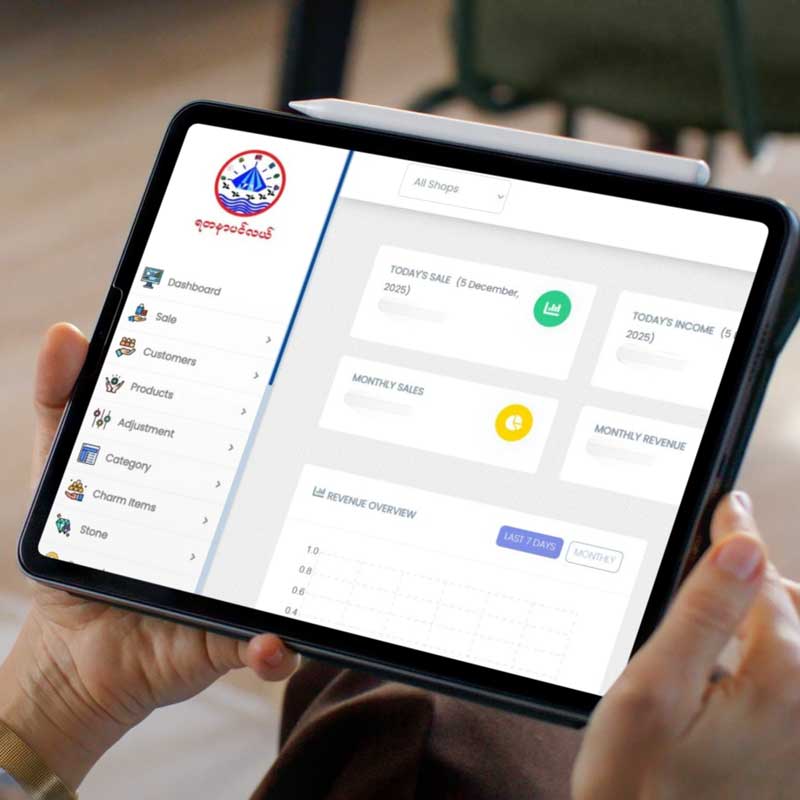
When we developed a dedicated POS system for a local jewelry company, we didn’t start with a template. We sat down with the owner to understand the daily headaches of the shop floor. We built a system that speaks the language of the Myanmar gold market and handles the complex buy-back cycles and local weight units natively.
The result wasn’t just a program, it was a tool that felt like a natural extension of the shop itself.
The Bottom Line is that don’t let your software be a barrier between you and your traditions. Your business logic is your competitive advantage, make sure your technology actually supports it.